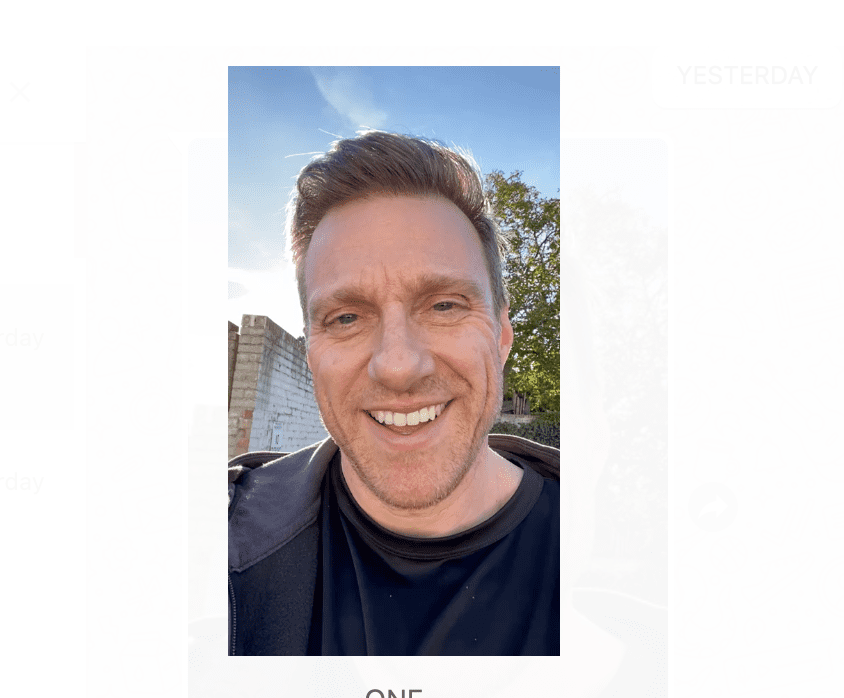
Mr A, who was a fit forty year old, hurt his lower back, for no obvious reason, whilst getting out of a chair. His back muscles suddenly went into spasm and he found it hard to straighten his spine. Being a regular gym enthusiast Mr A was used to the odd pulled muscle and assumed the pain would subside within a few days, which it did, though he was left with a sharp catching pain whenever he went to get out of a chair or attempted to arch backwards. Thinking this was just the residual effects of the pulled muscles in his lower back Mr A expected that given time the pain would go away of its own accord. However after more than 4 weeks the sharp catching pain was no different, so he decided to pay Spine Plus a visit.
At the initial assessment the Spine Plus Osteopath established that Mr A had jammed one of the small “facet” joints in his lower back. After performing a high speed thrust manipulation to release the stuck joint the Osteopath immediately asked Mr A to test his back by getting in and out of a chair and arching his spine backwards – Mr A was amazed to find he had no pain at all in his lower back and could arch backwards much further than before.
The Osteopath continued the remainder of the session by using deep massage and stretches to loosen Mr A's back muscles that had become shortened and tight due to his lack of mobility during the previous month. The Osteopath also explained that the initial incident had probably occurred because of some imbalance between Mr A's tummy muscles and his back muscles leading to the vertebral segments of his lower back not being supported properly. So the Osteopath showed Mr A some simple exercises to help correct the imbalance.
Mr A returned one week later for a check up on his lower back. He reported that has was still free of any pain in his back, in fact his back felt looser than it had done for a very long time.
For several years Mr B had noticed an ache and pinching sensation in his shoulder whenever he tried to raise his arm and take it out to the side. He remembered the pain had started out of the blue during a game of Tennis. His shoulder problem had previously been investigated with an MRI scan but nothing serious had been found and Mr B had not been offered any treatment.
After thorough examination of Mr B's shoulder and his overall posture the Osteopath discovered that the pain was being caused by a chronic strain and pinching of the muscles and tendons at the back of his shoulder. The strain was maintained by the position at which he held his shoulder which was related to the slight twist Mr B had through his middle back which was in turn compensating for tight muscles on one side of his hip.
The Osteopath started the treatment by using deep tissue release techniques on Mr B's posterior shoulder muscles. At the end of the first session Mr B's shoulder soon felt much better and he could raise his arm much more easily. However, the Osteopath explained that unless the other asymmetries in his spine and hip were addressed it would be likely that his shoulder problem would return.
Therefore during the subsequent treatment sessions, as well as continuing to release the muscles locally around his shoulder, the Osteopath worked on Mr B's back and hip. This was backed up with a series of exercises that the Osteopath showed Mr B to do at home.
After just 3 visits to the Osteopath Mr B had progressively less pain and more movement in his shoulder and was well on the way to a full recovery.
Mrs C was suffering from severe neck pain and painful pins and needles sensations in her left arm. When her symptoms first started she went to see her GP who prescribed anti-inflammatories and pain killers. Unfortunately despite trying different types of medication this did not significantly ease the pain so after seeing an advert in a newspaper Mrs C decide to go to a chiropractor.
The chiropractor treated her using purely spinal manipulation (clicking her neck). Mrs C had numerous treatment sessions with the chiropractor but her symptoms did not change and if anything got worse.
So she then went for some deep massage but again this did not help alleviate her symptoms.
On recommendation from a friend, Mrs C booked in to see the Osteopaths at Spine Plus. On initial examination her reflexes were normal but it was determined from the distribution of pins and needles in her left arm that she was suffering from a compressed nerve root in her neck between her C5 and C6 vertebrae. The Osteopath wrote a letter to her GP prompting an MRI scan.
The scan confirmed that Mrs C had considerable thinning of the discs in her neck (cervical spondylosis) and that the disc between C5 and C6 also had a bulge that was pressing on the adjacent nerve root causing the pain and pins and needles in her left arm.
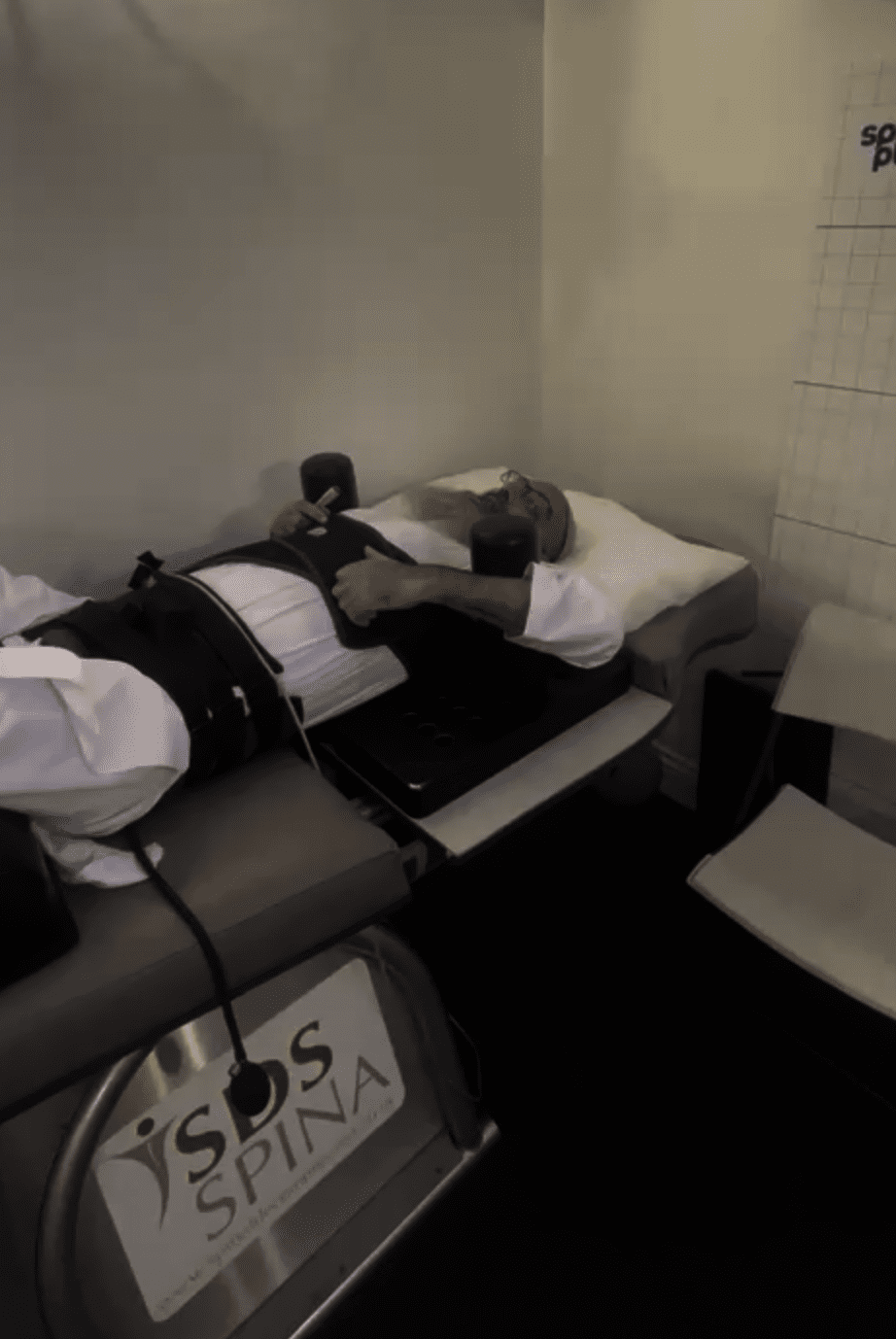
The Osteopath discussed his proposals with Mrs C, he suggested using a form of mechanical traction called “Intermittent Sustained Spinal Traction” (ISST). The Osteopath explained that rather the use the more common traction equipment involving the patient sitting he would use the ISST traction device that would allow Mrs C to lie down. The Osteopath also proposed using some different spinal manipulation techniques to those that had been used by the chiropractor, he explained that he would not manipulate the actual segment that had the disc bulge as this had the potential to damage the disc even more. He did suggest manipulating some of the segments above and below the disc bulge since he could feel that some of these joints were stiff and if they could be loosened this would probably help reduced the strain of the C5/6 disc. In order to limit trauma to the already injured discs he explained that these manipulation techniques would not involved rotation / twisting movements.
The Osteopath also gave Mrs C some advice about her posture and showed her some exercises designed to reduce the postural strain on her C5/6 area.
Mrs C thanked the Osteopath for helping accurately diagnose the problem and explaining in detail his rationale behind the proposed treatment methods, she agreed whole heartedly to this course of action.
The very next day after her first session of intermittent sustained traction Mrs C noticed reduced pain and reduced pins and needles for the first time since her symptoms had begun.
After a few weeks of having treatment twice per week Mrs C was virtually symptom free. The interval between treatments was then quickly and progressively extended in accordance with when Mrs C could feel her symptoms starting to return.
Mrs C now returns just 4 times a year to keep her symptoms at bay.
On recommendation from her sister, who had previously been treated at Spine Plus, Mrs D came to our clinic to see one of our Osteopaths. Mrs D had experienced frequent debilitating headaches for more thant 10 years. She had had many previous consultations and investigations with specialists who had all ruled out migraines or any serious pathology. Some of the specialists had told her that stress was the likely cause of her headaches and had even told her she might be clinically depressed. However Mrs D always explained that she considered herself to be a very positive person, she had a loving supportive family and was far from stressed. A distinct and definite explanation for her headaches had never been found.
In the past Mrs D had been referred for physiotherapy at her local hospital on several occasions, this involved very little hands on treatment but lots of exercises prescription. Mrs D had always religiously done the exercises that had been recommended to her. However, despite her perseverance these never seemed to help her. The only thing that provided relief from her symptoms was the strong medication prescribed by her GP/specialist but this also produced significant side effects that Mrs D found undesirable.
She had given up hope of ever finding significant long term relief and only turned attended the consultation at Spine Plus because she was literally dragged along by her sister. The Spine Plus Osteopath asked Mrs D to show him the exact place in her head where she experienced the headaches, he soon set to work examining Mrs D’s neck and shoulders.
Within a few minutes the Osteopath identified a couple of specific points deep in Mrs D’s shoulder/neck muscles. He explained that he was going to use some deep pressure on these areas and that she should tell him what she felt as he did this. After less than 30 seconds of this deep pressure being applied Mrs D exclaimed in that she could feel her usual pattern of headache coming back. The Osteopath reassured her that this was perfectly normal and indicated it was likely he found the “trigger points” that were causing her headaches. He continued by using “hands on” treatment aimed directly on the tissues identified. Whilst he was treating, despite having already taken a full case history, the Osteopath questioned Mrs D again about any injuries to the area It was then that Mrs D recalled having had whiplash about 10 years previously, around the time that the headaches had first emerged. The Osteopath explained that he thought it was this combined with her previous occupation involving long hours at a computer that had caused trauma to the soft tissues in her neck and shoulders resulting in the trigger points causing her headaches.
By the end of the session Mrs D remarked that she strangely felt a lot looser. At the next session, one week later, Mrs D told the Osteopath that she had had more relief from the previous treatment than anything she had tried before, she had only had about half her usual number of headaches and these were much less severe than normal. Despite this good response the Osteopath explained that because of the chronic nature of her problem he thought it would still take quite a number of treatments to fully resolve her headaches. Therefore it was agreed to teach Mrs D’s sister some trigger point release techniques that she could use on Mrs D on a regular basis, this would then reduce the number of times Mr B needed to see the Osteopath.
Within six months of regular trigger point release techniques administered by her sister and four more trips to see the Osteopath Mrs D had near permanent relief from her headaches and had stopped taking all her medication!
Whilst on business in the area Mr E presented to one of the Osteopaths at the clinic. He had chronic low back pain and more recent severe sciatica. Mr E’s job involved lots of heavy lifting, however his sciatica was making this increasingly difficult, he requested a “quick click of his lower” back, as performed by his regular Osteopath to try and get him through the next few days at work.
On further questioning it was obvious that his frequent trips to his regular Osteopath mainly involved spinal manipulation, this was providing some mild temporary relief for his low back pain but if anything his sciatica was getting worse with time. He had also been having some deep massage from another therapist, this did provide some relief from the sciatica but it was very short lived, only for a day or two. As soon the Spine Plus Osteopath felt Mr E’s lower back he noticed something didn’t seem quite right and refused to manipulate the joints in his lower spine that Mr E wanted.
The Osteopath strongly suggested to Mr E that he have an MRI scan of his lower back in order to assess the health of his spine further and to point the way to the most appropriate treatment. Mr E had medical insurance that would pay for the scan but only with referral from a spinal surgeon. So the Osteopath suggested a colleague who was a surgeon and who would be able to arrange for the scan to take place and be reported on at Vista Diagnostics.
Mr E declined the suggestion wanting instead to consult a particular surgeon he knew in his home town. Mr E did eventually see this particular surgeon who duly arranged for the MRI at Mr E’s local private hospital. Following the scan Mr E went back to this surgeon, the surgeon pointed to the pictures of the scan and told Mr E there was “nothing wrong” with his lower back and that the cause of his sciatica was purely muscular, furthermore he showed Mr E a copy of the radiologist’s report which also said there were no untoward findings.
Soon after, Mr E telephoned the Spine Plus Osteopath to tell him the apparent news that no abnormalities had shown up on the scan. The Osteopath was so surprised by this news that he insisted Mr E come back in to see him with copies of the scan.
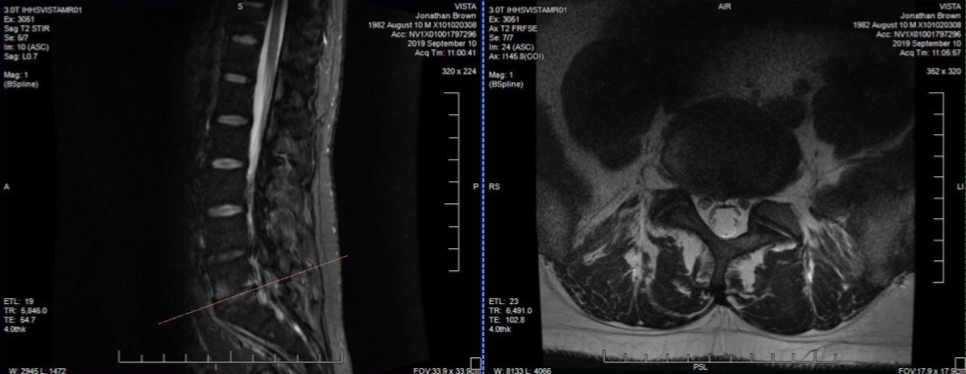
Straight away the Osteopath pointed to an area on the scan which correlated with the part of Mr E’s spine where the Osteopath had felt a problem with his hands (at L4/5), even Mr E had to agree it did not look right.
Our Osteopath then suggested that Mr E allow him to arrange a second radiologist’s report from the radiologist at Vista Diagnostics whom he had wanted to provide the original report. The vista radiologist’s report came back indicating that Mr E had a torn bulging disc at L4/5, a forward slippage of L4 on L5 (a “spondylolisthesis”) and more alarmingly a stress fracture in the vertebra at L4 – all of which had been missed by the first radiologist and spinal surgeon!
On hearing this news, especially regarding the stress fracture Mr E thanked the Osteopath for refusing to “click” his back when they had first met.
At the time of writing Mr E has had three further sessions of treatment and exercise advice from the Osteopath none of which have involved any heavy manipulation (clicking) of his lower back. Mr E’s still has some residual low back tenderness but this is much reduced and continuing to improve, his sciatica has completely resolved and he has even been able to resume some lifting without any ill effects.
If his symptoms do deteriorate Mr E is now in full agreement to consult with a spinal surgeon as recommended by our Osteopath.
When Mrs Smith first went to visit her GP with her hip pain her GP referred her to see her local NHS orthopaedic consultant. The orthopaedic consultant sent Mrs Smith for an MRI scan of her right hip and subsequently told her that her pain was due to mild arthritis but that it was not severe and she would improve with some physiotherapy. Following several sessions of NHS physiotherapy Mrs Smith had made no improvement in her pain and it was at this point that Mrs Smith’s GP recommended at consultation with one of the Spine Plus Osteopaths.
On careful examination it was revealed that Mrs Smith was getting excruciating bouts of pain on certain hip movements, out of character for “mild” arthritis. Spine Plus then got in contact with Mrs Smith’s GP and arranged for her MRI scan to be sent to one of the consultant radiologists who works at Vista Diagnostics and also at The Royal National Orthopaedic Hospital (RNOH), Stanmore. He reported that along with the mild arthritis Mrs Smith also had multiple hairline fractures of her hip caused by a lack of blood supply, a condition called “Avascular Necrosis”, this correlated with the severe symptoms that she was experiencing.
Mrs Smith was immediately referred by Spine Plus to a different Consultant who treated her with injection therapy. This greatly improved her pain levels and Mrs Smith was soon happily going about her daily routine.
Spine Plus Clinics, working in association with


![]()